
From Farmland to Thriving Business Centers: How Lake Norman Commercial Real Estate Grew Up
Twenty years of growth across Huntersville, Cornelius, Mooresville and Davidson, and roots that go back a whole lot further.
A farmer who bet on Davidson
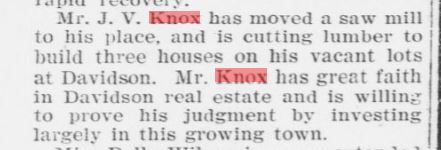
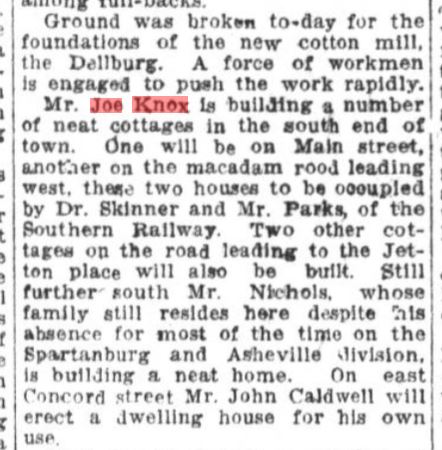
Back in 1907, the Charlotte Observer ran a little item about a Davidson farmer named Joe Knox. He'd moved a sawmill onto his own property so he could cut lumber and build houses on his empty lots. According to the paper, he had great faith in Davidson real estate and was ready to back it up with his own money.
 Click to enlarge
 Click to enlarge
Turns out he was right. He was just about a hundred years ahead of everybody else.
Anybody who's lived around Lake Norman for a while has watched that bet pay off in real time. Twenty years ago, a lot of what feels like "town" now was pasture, two-lane roads and maybe a gas station. These days we've got mixed-use villages, corporate campuses, a brand-new hospital and more dinner spots than anyone could possibly count.
So let's walk through it: how the Lake Norman commercial real estate market went from farmland to busy business centers over the last two decades, why that growth has made life here easier, and how far back the story actually goes.
Before the lake: Lake Norman farmland and the people who built on it
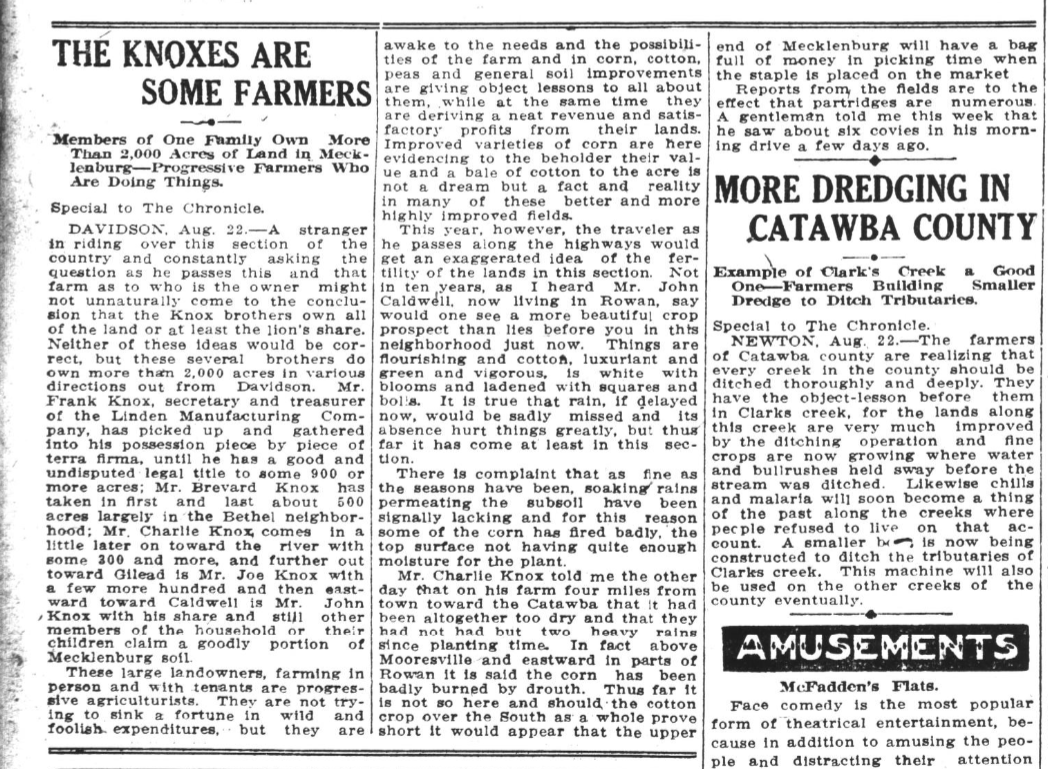
Long before anybody called it Lake Norman, North Mecklenburg was farm country. In 1910 the Charlotte Chronicle ran a story titled "The Knoxes Are Some Farmers" about the family's 2,000-plus acres of farmland around Davidson. Joseph Van Buren Knox's piece of that was about 300 acres running out toward Mt. Gilead. In 1896 he and his brothers, Thomas Brevard and Robert Chalmers, also went in together on 114 acres in Lemley Township.
 Click to enlarge
Joe didn't stay just a farmer for long, though.
He and his brother Frank built a big chunk of south Davidson, the area below what's now the Village Store, and he had four homes finished there by 1907. The county hired him in 1920 to build a schoolhouse at Cowan's Ford. He also built the First Union Bank building on Main Street and kept that job going right through the Great Depression. It's a Wells Fargo branch now, but in the family it's still "Granddaddy Joe's building."
People tend to talk about growth around here like it showed up with I-77. The families who settled this area were putting up homes, storefronts and schools for a growing town more than a hundred years before the interstate.
The Knox family is spread out these days, but plenty of them stayed in the building business, and Knox descendants are still developing and managing property across North Mecklenburg today.
Joe's whole story is in Part Five of the Knox Family Legacy series, and you can start from the beginning with the Knox Family Legacy Project.
1963: the lake redraws the map
If you had to pick one turning point in Lake Norman real estate history, it'd be the lake itself. Duke Power broke ground on Cowans Ford Dam in 1959. By the summer of 1963, the Catawba River had backed up into a 32,000-acre lake with more than 500 miles of shoreline, touching Mecklenburg, Iredell, Lincoln and Catawba counties.
A lot disappeared beneath the water. Farms, churches, roads, whole mill villages. The Long Island Mill, one of the oldest cotton mills in the South, closed in 1959 to make room. Even the dam's name comes from Cowan's Ford, the same community where Joe Knox had built that schoolhouse about forty years earlier.
The families who kept their land above the new waterline suddenly owned lakefront. Over time, Lake Norman farmland turned into Lake Norman properties, though for a few decades that mostly meant fish camps, weekend cottages and bait shops. Once I-77 came through and people realized they could live on the water and still commute to Charlotte, things really started moving.
The early 2000s: Huntersville gets a downtown of its own
By the mid-'90s, Huntersville and the other lake towns could tell what was coming. They rewrote their development codes to encourage walkable, mixed-use projects instead of one strip center after another. Birkdale Village was the first big test of that idea.
It's built on 52 acres that used to be a dairy farm. The town signed off in 1997, construction started in 1999, and it opened in 2003 with apartments over Main Street-style shops, office space, a movie theater and a long town green down the middle. Nothing that size had been tried in North Carolina before, and it picked up a national design award from the International Council of Shopping Centers in 2004.
 Click to enlarge
Twenty-plus years later, developers all over the Charlotte region still sell their projects as "the next Birkdale."
When the place started looking a little dated, the new owners put money back into it instead of letting it slide. Huntersville unanimously approved a $55 million retrofit in 2021 that added new gathering spaces, a stage and more room to walk around. Honestly, that kind of reinvestment is one of the best signs a commercial property was built in the right spot.
And the demand was there. Huntersville had about 25,000 people in 2000 and over 61,000 by 2020. Zoom out and Mecklenburg County growth looks even bigger, with roughly 420,000 new residents in that same stretch, and every one of them needed somewhere to shop, eat and work.
Cornelius: from Exit 28 to Bailey Road
Cornelius might be the fastest grower of the bunch. Just under 12,000 people lived there in 2000. By 2020 it was over 31,000.
West Catawba Avenue off Exit 28 turned into the town's main commercial strip, full of restaurants, medical offices, grocery stores and all the everyday stuff that used to mean a drive to Charlotte.
The newest growth is up by Bailey Road and U.S. 21, where Atrium Health Lake Norman opened on July 1, 2025. It's a 171,000-square-foot hospital with 36 beds, an emergency department and a labor and delivery floor. Before it was built, the town's mayor pointed out that Cornelius residents using Atrium usually had to go to Cabarrus County or uptown Charlotte for elite hospital care.
In our experience, a hospital pulls a lot of other business along with it: medical office space, pharmacies, restaurants and services. The roads are already being set up for that. In March 2026, NCDOT awarded a $7.8 million contract to extend Bailey Road about half a mile to U.S. 21, with a new signal in front of the hospital, a roundabout at Poole Place Drive and a link to the Caldwell Station Creek Greenway. The road part should be done in fall 2027.
Mooresville and Davidson: two towns, two speeds
Mooresville was a mill town for more than a hundred years before it became Race City USA, home to dozens of NASCAR teams and all the suppliers that come with them. Then in the early 2000s, Lowe's moved its corporate headquarters there from Wilkesboro. That brought in hundreds of vendors who wanted office and flex space close to the new campus, and the population jumped from about 18,800 in 2000 to over 50,000 by 2020.
Which brings us to River Highway. If you've ever tried to get anywhere on N.C. 150 at 5:15 on a weekday, you already know the road fell a little behind everything built along it. It's finally getting some attention. NCDOT has a $249 million project widening 5.5 miles of N.C. 150 from Greenwood Road to U.S. 21, which includes rebuilding the I-77 interchange at Exit 36 into a 10-lane bridge, a new bridge over the lake and a multi-use path into town.
Williamson Road is up next, including a new signal at Joe Knox Avenue. That street is named for Joe Knox, grandson and namesake of Joseph Van Buren Knox and uncle to Knox Group Vice President Steve Knox, and President Charles Knox. It's been fun seeing the family name still on the map more than a century after Joe built his first houses in Davidson.
Davidson went the other direction, and that was totally intentional. The town adopted a General Plan in 1993 and a planning ordinance in 2001 that's several hundred pages long, which gave it some of the most detailed growth rules in the state. For years, Exit 30 at Griffith Street was the last undeveloped I-77 exit in Mecklenburg County.
Taking it slow worked out fine for them. Davidson is now home to Sherwin-Williams, Ingersoll Rand and MSC Industrial. A Hyatt Place got the green light at Griffith Street and Davidson Gateway Drive, and the town has flagged a 29-acre site on N.C. 73 as a main spot for future mixed-use growth.
For a little perspective, Davidson had about 500 residents in 1910. It's past 15,000 today.
When the roads play catch-up
Growth around here tends to happen in a certain order, and it helps to know why. A shopping center or office building can go from rezoning to ribbon-cutting in a couple of years. A state road project has to wait in line for funding, buy right-of-way, and move every utility line in the way before anyone paves a new lane. So the businesses usually get here first, and the roads follow a few years later.
West Catawba Avenue is a good example. The section between Jetton Road and Sam Furr Road (N.C. 73) carries far more traffic than its two lanes were ever designed to handle, and Cornelius has been asking for a fix for almost twenty years.
That fix is happening now. NCDOT is widening about 2.7 miles of it to four lanes, with a center median and 8- to 10-foot walking and biking paths on both sides. The project runs about $35 million and will make getting between Cornelius and Huntersville a whole lot easier. Right-of-way purchases are done, crews are moving utilities, and the state is aiming to finish around 2030.
There's also a separate $21 million project closer to the interstate adding roundabouts and safer turns near Liverpool Parkway and Torrence Chapel Road. That one's due by spring 2028.
I-77 went through the same thing. By the time the express lanes opened from Huntersville to Mooresville in June 2019, years of growth had already packed the corridor with commuters. When orange barrels go up around here, it usually means a lot of people decided they wanted to live and do business nearby, and the state is finally making room for them.
Why NC commercial development matters as the lake grows
Put Huntersville, Cornelius, Mooresville and Davidson together and you had roughly 63,000 people in 2000; by 2020 it was more than 155,000. That's two and a half times as many households looking for groceries, doctors, dentists, daycares, gyms, office space and somewhere decent to grab a drink after work.
If none of that gets built locally, every one of those errands turns into a drive down I-77. When it does get built, people can live, work and spend money in the same town, and the tax revenue stays here to pay for schools, parks and wider roads.
Each town has gone about it a little differently. Birkdale proved early on that mixed-use could work this far from uptown, Davidson has grown on its own careful terms and still landed big employers, and Cornelius now has its own hospital.
If you're an investor or a business owner, here's our best advice: follow the road money. West Catawba, Bailey Road and N.C. 150 are all getting major state investment right now, and in our experience that's usually when the Lake Norman properties along those corridors really start to come into their own.
Deep roots, still growing
Joe Knox set up that sawmill more than a hundred years ago because he believed Davidson was worth building. The farmland he worked is neighborhoods, storefronts and business parks now, and the bank building he finished during the Depression still opens its doors every morning.
We think good growth around Lake Norman still looks a lot like that. Respect what was here first and build for the folks who are coming next. The roads will catch up eventually (River Highway, we're looking at you).
The Knox family has been at some version of this in North Mecklenburg for generations, and The Knox Group is still doing it today in Cornelius, Davidson, Huntersville and Mooresville.
Know the ground you're building on
If you want the whole family story, start with the Knox Family Legacy Project. If you're shopping for Lake Norman properties for your business, or you're just curious what used to sit on that corner, give us a call.